
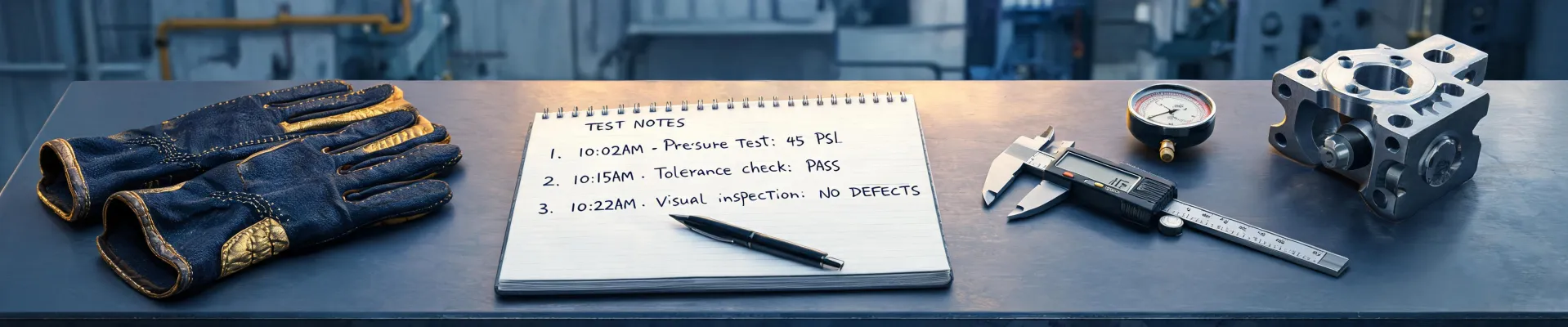
Day 11 of the Pilot
March 19, 2024. One of our welding assistants walked into my office holding a nitrile glove with a hole melted through the palm. The edges had curled and gone hard, like plastic left too close to a stove burner.
He'd shifted a steel fixture that had come out of the weld booth six minutes earlier. He'd left his welding gloves at the other bench because it was supposed to be a ten-second job. It turned into four seconds of contact, maybe five.
"These are the heat ones, right?" he asked.
They were not the heat ones.
That was day 11 of what was supposed to be a three-week PPE pilot across six job sites. By then I already suspected the $5,200 in projected savings wasn't going to survive the year. I just didn't know yet what it would cost instead.
January: Why We Went to Bid
Some context. I handle quality and brand compliance for an industrial supply company—which means I'm the last person who signs off before a product ships to a customer, and the first person who gets the phone call when something's wrong. Over four years in this seat I've reviewed somewhere north of 400 SKUs a year.
In January 2024 we decided to consolidate PPE purchasing. We had seven vendors for head-to-toe gear, roughly 140 field workers across six sites, and a procurement team that understandably wanted fewer invoices to reconcile. Everyone agreed the target was a 10-12% reduction in annual spend.
I was handed the spec sheet. That's where the trouble started.
Here's what I wrote in the first draft, more or less verbatim. "Hard hats must meet ANSI Z89.1. Safety glasses must meet ANSI Z87.1. Gloves must be appropriate to task."
That reads fine. It's also close to useless.
ANSI/ISEA Z89.1 covers Type I and Type II helmets, and those are not the same product. Type I protects against impact from the top. Type II adds lateral impact protection—the side of the helmet, which matters when you're working under conveyor lines, staging decks, or alongside a lift. OSHA's 29 CFR 1910.132 requires employers to base PPE selection on a documented hazard assessment, not on a catalog page. I knew that. I still wrote one straight line into a spec that covered six very different job sites.
The $5,200 Question
The bids came back in mid-February. Our incumbent bundle landed at $46,800. A lower-cost supplier came in at $41,600.
Eleven percent. On paper, that's the whole project goal delivered in one line item.
I sat with it for a couple of days. The upside was straightforward: $5,200 back to the budget, a clean story for procurement, and a supplier hungry enough to answer emails on a Saturday.
The risk was harder to name. Somewhere in the back of my head was a 2022 batch—different category, doesn't matter which—where the certificate said one thing and the actual product behaved differently. We caught it at receiving. The vendor claimed it was "within industry standard." We rejected the lot, they redid it at their cost, and I spent six weeks rebuilding a delivery schedule.
I kept asking myself whether $5,200 was worth that again. Worst case, roughly $9,000 in rework and a bruised relationship with one of our general contractors. Best case, a clean win. Expected value said take the low bid. My gut said I'd written that spec in an afternoon and shouldn't trust it that far.
So I proposed something procurement didn't love: split the pilot. Three sites on the low bidder, three on our existing configuration. Three weeks. Full receiving inspection on both. I told them if the low bidder performed, we'd roll out in Q2 with a bigger volume discount than the original quote.
They agreed. That decision is the only reason this is a lesson instead of a disaster.
What Three Weeks Turned Up
The Hard Hats: My Spec Was the Problem, Not the Supplier
The low bidder shipped a single Type I, standard-brim helmet to all three pilot sites.
Two of those sites were fine. The third wasn't. We had crews working under a pipe rack and beneath staging decks, and that's a lateral-impact conversation. The helmet on the dock was the wrong tool, and the spec sheet I wrote let it through because "meets Z89.1" doesn't say which part of Z89.1.
The brim issue was subtler. For two years our outdoor paving and utility crews had been wearing Pyramex Ridgeline hard hats in the full-brim configuration—the Pyramex hard hat full brim version—and the reason wasn't aesthetics. A full brim keeps sun off the neck and ears in July, and it sheds rain off the face instead of down the collar. On a 100-degree day that's not a luxury. It's the difference between a crew that keeps the helmet on and one that quietly takes it off when nobody's watching.
But full brim is wrong indoors. Low ceiling, tight rack, working overhead—that brim catches on everything and blocks your upward view. We'd been quietly doing the right thing by buying two configurations and not thinking about it. The bid process stripped that away because our spec never said it out loud.
So we shipped 60 helmets back and reordered the split configuration. The low bidder couldn't fill it on our schedule. That's not really their fault. We never told them we needed two products.
No, Nitrile Gloves Are Not Heat Resistant
The glove incident is the one that got leadership's attention, so let me answer the question directly, because I hear it in almost every new-hire orientation:
Nitrile gloves are not heat-resistant gloves. Nitrile is a chemical barrier. It's excellent against oils, greases, and a long list of solvents. It is not a thermal barrier. Disposable nitrile has effectively no contact-heat rating, and even heavy coated nitrile isn't built for handling hot parts.
If you need contact-heat protection, you're looking at a glove with an actual heat rating. ANSI/ISEA 105 includes contact-heat ratings; EN 407 handles thermal risks separately. In practice that usually means leather or leather-palm work gloves for moderate handling, welding gloves or aramid for higher temperatures, and aluminized or specialty gloves for radiant heat. Our hand-protection standard now lists mens leather gloves as the default for material handling, with a separate heat-rated line for weld-adjacent work.
What went wrong in the pilot wasn't exotic. The low bidder's glove box said "heavy duty" in large letters. Our own people read "heavy duty" and inferred "tough enough for anything." That's a labeling gap and a training gap, and I own both of them.
Nobody was seriously hurt. The welding assistant had a red palm and a bruised ego, and he now helps me run glove-selection training, which he finds funnier than I do.
The Boots Were the Tell
The last thing we looked at was footwear. We'd been specifying Georgia work boots for the field crews for a while—not because they're the only decent boot, but because they held up and the sizing was predictable, which matters when you're ordering 40 pairs at once.
The low bidder offered a house-brand alternative at about 35% less per pair. I approved 22 pairs for the pilot, because that's what a pilot is for.
Fourteen weeks later, six of those 22 pairs had blown out at the welt or the toe cap. Two guys asked to go back to the old boots on their own dime before I'd even finished the review.
I want to be careful here. That's 22 pairs, one site, one season. It's anecdote, not data. I've had early failures on good boots too. But the pattern was clear enough to act on: the cheap pair cost 35% less and lasted roughly a third as long, which isn't a savings. It's a payment plan.
The June Invoice
Here's what the year actually looked like, unit price included.
- Quoted savings: $5,200
- Expedited re-buy on split-configuration helmets (retail, because the original schedule was gone): $2,340 over plan
- Return freight, restocking, and receiving labor on 60 helmets: $1,180
- Footwear overrun for the year, measured by replacement frequency rather than unit cost: $4,900
- Six hours of lost production plus the incident review after the glove burn: $3,100
- My time on returns, reorders, and documentation—about 70 hours—roughly $4,200 loaded
Net result: instead of saving $5,200, we spent about $10,500 more than the original plan. On a category we thought we'd already optimized.
I have mixed feelings about that number. Part of me is proud we ran a pilot and caught it at three sites instead of six. Another part knows the pilot only caught something because I'd written a lazy spec, and the $5,200 was never real to begin with. It was a number on a bid sheet that hadn't been stress-tested.
What Changed in the Spec Sheet
Four things, all boring, all cheap.
One: specs are now written by job site, not by category. The helmet line in our current document says Type I for general site work, Type II for the two sites with overhead and lateral exposure, full brim for outdoor crews, standard brim for interior and low-clearance zones. Same for eyewear—anti-fog matters on mask-required tasks and we now specify it as its own line instead of assuming it comes bundled.
Two: compliance submissions require the configuration, not just the standard. "Meets Z89.1" is not a submission. A model number, a rating class, and a current test report is.
Three: gloves are classified by hazard. Chemical, cut, abrasion, heat, electrical—each with a minimum rating. The phrase "heavy duty" is now banned from our internal documents, because it means nothing.
Four: every contract over a set dollar threshold includes a pilot clause. Three sites, three weeks, documented receiving inspection, exit rights if it fails. Our legal team complained about it for a month and has since used it twice.
The thing I keep coming back to is that none of this was clever. We were doing most of it by habit before the bid forced it onto paper. The bid didn't create the risk. It just made the risk visible and then priced it.
Dodged a bullet, honestly. Six more sites and I'd have spent a quarter doing returns.
The unit price is a proposal. The invoice is what actually happened.

Mariko Sato
Mariko Sato is a workplace emergency-response equipment analyst covering industrial first-aid kits, AEDs, eyewash stations, emergency showers, burn kits, spill kits, bloodborne-pathogen kits, and fire extinguishers. She references ANSI Z308.1, ANSI/ISEA Z358.1, IEC 60601-2-4, and NFPA 10 while examining supply class, treatment capacity, activation time, flow rate, tepid-water delivery, shock energy, inspection interval, extinguisher rating, and placement distance. Her guides help EHS managers, facility teams, clinics, warehouses, and buyers plan equipment quantities, locations, maintenance, replenishment, responder access, and compatibility with site-specific emergency scenarios.
Leave a Technical Comment